Racial Stasis: The Millennial Generation and the Stagnation of Racial Attitudes in American Politics by Christopher D. Desante & Candis Watts Smith
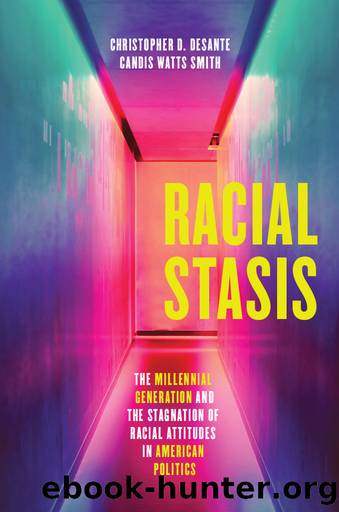
Author:Christopher D. Desante & Candis Watts Smith [Desante, Christopher D. & Smith, Candis Watts]
Language: eng
Format: epub
Tags: Ethnic Studies, American, Social Science, African American & Black Studies, Political Science, American Government, General
ISBN: 9780226643762
Google: l1XODwAAQBAJ
Publisher: University of Chicago Press
Published: 2020-02-25T13:08:28+00:00
Quotas: You Do It on Percentages
The most prevalent way that our respondents understood affirmative action and race-conscious admissions policies was via the notion of âquotas,â even though the US Supreme Court outlawed quotas several decades ago. The Supreme Courtâs decision in Regents of the University of California v. Bakke (1978) upheld affirmative-action policies, allowing race to be considered among a number of other characteristics in college admissions policies and processes, but ultimately the court ruled that quotas or a specific number or proportion of set-aside seats was unconstitutional. This case occurred long before anyone in the millennial generation was born, and furthermore, it occurred when many of those in Generation X were teenagers; in all, two generations have lived in an America where quotas in college admissions are banned, but we see that the plurality of our respondents expressed a belief that affirmative-action policies nonetheless enable a quota system. About 40 percent (sixteen) of our respondents believed that these kinds of policies were to, in Chloeâs words, âreserve spots for certain people.â As Grayson explained, âIâd say kneejerk, I think of quotas.â Even though millennials have been socialized in a different social and political milieu than their predecessors, theyâve gained insight about the way the world works from members of previous generations and use those insights to inform their policy preferences.
Rather than seeing affirmative action as a compensatory policy that provides greater opportunity for future success, 40 percent of our respondents viewed affirmative action as a policy that gives unfair and unnecessary preferential treatment to some groups over others. Ophelia provided an example of this sentiment. When we asked her what comes to mind when she thinks of affirmative action, she said, âI think of quotas and like letting a certain number of different races into a school.â She explained how a system like this works: âLike you know if you set a number, maybe you have this like five people from Alabama. And then only five people from Alabama apply, you know? Thatâs just like, thatâs an example likeâthat seems silly then that you would have to admit all those kids if you have a couple kids from New Mexico who are more qualified.â Actually, the Supreme Courtâs most recent landmark decisions on race-conscious admissions policies, Grutter v. Bollinger (2003) and Gratz v. Bollinger (2003), also known as the University of Michigan cases, reaffirmed that universities may take race into consideration among many other factors, noting that the hallmark of the University of Michigan Law Schoolâs admissions policy âis its focus on academic ability coupled with a flexible assessment of applicantsâ talents, experiences, and potential âto contribute to the learning of those around themââ (Grutter v. Bollinger, 2003). In this case, the court reiterated that quotas are âpatently unconstitutional,â and ultimately determined that there is a compelling state interest to attain a diverse class. Justice Sandra Day OâConnor, in the majority opinion for Grutter, explained: âIn order to cultivate a set of leaders with legitimacy in the eyes of
Download
This site does not store any files on its server. We only index and link to content provided by other sites. Please contact the content providers to delete copyright contents if any and email us, we'll remove relevant links or contents immediately.
| Anthropology | Archaeology |
| Philosophy | Politics & Government |
| Social Sciences | Sociology |
| Women's Studies |
Born to Run: by Christopher McDougall(7131)
The Leavers by Lisa Ko(6949)
iGen by Jean M. Twenge(5418)
Sapiens by Yuval Noah Harari(5374)
Spare by Prince Harry The Duke of Sussex(5200)
The Kite Runner by Khaled Hosseini(5184)
Machine Learning at Scale with H2O by Gregory Keys | David Whiting(4315)
Bullshit Jobs by David Graeber(4195)
Never by Ken Follett(3960)
Goodbye Paradise(3812)
Livewired by David Eagleman(3776)
Fairy Tale by Stephen King(3401)
A Dictionary of Sociology by Unknown(3086)
Harry Potter 4 - Harry Potter and The Goblet of Fire by J.K.Rowling(3076)
The Social Psychology of Inequality by Unknown(3037)
Will by Will Smith(2928)
The Club by A.L. Brooks(2927)
0041152001443424520 .pdf by Unknown(2849)
People of the Earth: An Introduction to World Prehistory by Dr. Brian Fagan & Nadia Durrani(2739)
